
CSA Weekly Update (05.29.2026)
On the May 29th, 2026, edition of the CSA Weekly Update:
New Podcast Episode - The Business of Food Safety: Counties & the Restaurant Industry with Dan Bogert
JLBC Monthly Fiscal Highlights: May Fiscal Highlights
New CSA Toolkit: What Lawmakers Need to Know About Arizona's Counties
Lions, Tigers, and Ballot Referrals, Oh My! CSA Legislative Update
Save the Date: CSA Annual Policy Summit
Where to Watch: Upcoming Live Proceedings
Lifelong Learning: Upcoming NACo Webinars
New Podcast Episode - The Business of Food Safety: Counties & the Restaurant Industry with Dan Bogert
This week on Creatures of Statute, we sat down with Dan Bogert, COO of the Arizona Restaurant Association, to discuss the intersection of county government, public health, and Arizona’s restaurant industry. The conversation explored food safety regulations, health inspections, permitting, and the vital role local restaurants play in Arizona’s economy and communities. Tune in for an inside look at how industry and local government work together to support public health and small businesses across the state.
Check out the Arizona Restaurant Association here.
View current and previous winners of the Foodist Awards here.
JLBC Monthly Fiscal Highlights: May Fiscal Highlights
The Joint Legislative Budget Committee (JLBC) recently released its May Monthly Fiscal Highlights, providing a preliminary look at Arizona’s General Fund revenue through April 2025.
Through April, the state collected $2.02 billion, a 9.1% increase over the prior year. Fiscal year-to-date, General Fund Revenues are 3.5% above the prior year, generating a forecast gain of $55 million.
Sales Tax:
Fiscal year to date, sales tax collections in April were 3.8% above the prior year, generating a forecast gain of $55.1 million. Contracting revenues continued to grow by 5% year-over-year, marking yet another month of improvement after seven consecutive months of declines for this category yet still posting declines of (2.0)% FYTD. Preliminary data from the Department of Revenue suggests that the recent improvement is primarily attributable to the Nonresidential Construction industry, including industrial and commercial buildings. The retail/remote seller category grew by 4.9% year-over-year, while the restaurant and bar category posted minimal growth of 0.5%.

Individual Income Tax:
Net revenue in April was $764.8 million, posting 4.7% growth over the previous year and generating a forecast gain of $10.9 million. Payments and withholding revenue offset higher levels of refunds, resulting in that gain. Withholding revenues grew by 5.3% over the prior year, commensurate with the recent national wage and salary growth reported by the Bureau of Economic Analysis. Payment revenues grew by 9.6%, while refunds grew by 12.1% over the previous year. On average, April refunds make up nearly 25% of the fiscal year total, and fiscal year to date, refunds have grown by 5.9% and generated a forecast loss of $(81.8) million.
Corporate Income Tax:
Net Corporate Income Tax revenues were $361.2 million in April, representing 26.6% growth over the previous year and contributing to a forecast gain of $65.8 million.
Insurance Premium Tax:
Insurance Premium tax collections were $164.3 million in April, an increase of 126.8% compared to the same month in the prior year and $8.5 million above the Baseline forecast. JLBC noted that the large year-over-year increase is primarily due to the timing of March installment payments, many of which were delayed until early April because of payment processing timelines and required validation procedures.
HURF Collections:
Highway User Revenue Fund (HURF) collections totaled $166.4 million in April, (0.4)% below the amount collected in April of 2025 and $(6.6) million below forecast. FYTD, HURF collections are 1.6% above the prior year and $(27.2) million below forecast.
To view the full fiscal highlights, click here.
New CSA Toolkit: What Lawmakers Need to Know About Arizona's Counties
As the legislative session wraps up, we wanted to make key county policy resources easier to access and reference. To support lawmakers and stakeholders beyond session, CSA has developed a Lawmaker Toolkit that brings together essential information in one place.

The toolkit provides a concise, easy-to-navigate overview of major state policies impacting county constituent services. It also includes links to additional background materials and resources for those seeking deeper context on key issues affecting Arizona counties.
You can access the full toolkit on our website here.
Lions, Tigers, and Ballot Referrals, Oh My! CSA Legislative Update
This session, legislators introduced 120 combined HCRs and SCRs. While this seems like a large number, not all of these items were destined to move forward for consideration on the ballot. Some of these measures were only resolutions, some were introduced by Democratic members and therefore never received a hearing, and some never received a hearing in committee or moved past their chamber of origin. Now that we're coming to the end of the legislative session, the number of potential ballot referrals has been significantly reduced until – as of now – there are only 24 left in the running.

Of the 24 referrals, only seven are county relevant and only two have moved past the rules committee in their second chamber. County relevant referrals include topics like elections, fee moratoriums, automatic salary adjustments for judicial officers, and prohibitions on medical mandates. The two that have gone the furthest - separate referrals - cover school district monies and bathroom policies.
Once the legislature returns from their hiatus, majority leadership in both chambers will need to decide which referrals have the highest likelihood of garnering support from their caucus and drawing out their desired voter base while weighing the potential for voter burnout if the ballot gets too lengthy. As a refresher, the Legislature passed three referrals last session, and the Secretary of State's Office believes there are three potentially viable citizen initiatives in play. We've heard the Legislature could be planning to select as many as five additional referrals to send to the ballot in 2026, meaning there could be as many as 11 total proposals for voters to decide on.
As the 57th Legislature, 2nd Regular Session progresses, the Association will continue to provide updates. Please find additional deadlines linked here as well as listed below:

Save the Date: CSA Annual Policy Summit
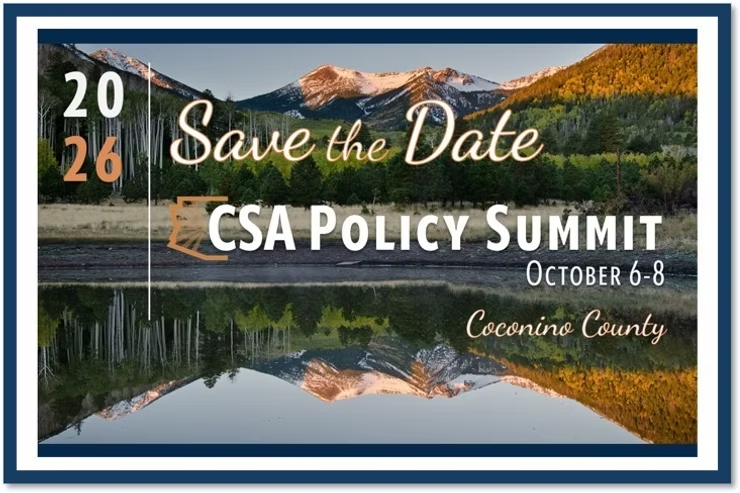
In October 2026, Supervisors from across the state will meet in Coconino County for the Annual CSA Policy Summit. The 61 county supervisors use this event to vote on the Association's 2027 legislative, budget, and research agendas. Registration details will be out soon. Looking forward to seeing you all there!
Where to Watch: Upcoming Live Proceedings
The Legislative Session has reached a critical point - committees are no longer regularly meeting to process bills. As such - barring meetings to evaluate executive nominations or to process the FY 2027 budget - most action will occur on the floor, in Rules, or in Caucus. These agendas are typically not released until the day before, so it becomes more difficult to predict what will happen. As agendas/calendars have not been posted for next week's action, we will be updating you on where to find agendas as they become available. CSA's staff will be sure to reach out if immediate action by Supervisors becomes necessary, and regular legislative updates will continue.
To see the full legislative calendar, click here.
To see live proceedings, click here.
To see archived meetings, click here.
Lifelong Learning: Upcoming NACo Webinars
Grassroots Advocacy Series: Unlocking Tools to Tell Your County Story
Tuesday, June 2, 2026 | 3 p.m. - 3:45 p.m. ET
Join us for the first webinar in NACo’s new Grassroots Advocacy Series, developed in response to County Pulse survey feedback and the creation of NACo’s grassroots advocacy role. This session will highlight how county leaders can leverage NACo tools and resources to effectively engage in federal advocacy. Attendees will receive a practical overview of existing platforms and features that support outreach and engagement, with guidance on how to use these tools to elevate county priorities at the federal level.
To register, please click here.
NACo Policy Insider Webinar Series: Understanding the Federal Landscape for Counties, June 4
Thursday, June 4, 2026 | 3:30 p.m. - 4 p.m.
Last year's Inside Washington series is now NACo Policy Insider, a bi-weekly webinar offering an overview of the full federal policy landscape impacting counties, as well as deeper dives into specific policy areas, equipping county leaders with insights, context, and strategies to engage effectively on key issues from transportation and infrastructure, to public lands, to health and human services, and more.
To register, please click here.
Leveraging Opioid Settlement Funds for Housing Supports: Strategies for Counties
Monday, June 8, 2026 | 1 p.m. - 2 p.m. ET
Counties across the country are working to expand safe and supportive housing for their residents with substance use disorder, recognizing housing as a critical part of the recovery continuum of care. This webinar will highlight practical strategies for using opioid settlement funds to support housing initiatives at the local level. Given ongoing ambiguity around allowable uses of settlement funds, the session will offer clear guidance on emerging models, compliance considerations and opportunities to fund housing as part of broader recovery infrastructure.
Funding for this workshop was made possible by the Centers for Disease Control and Prevention. The views expressed in written conference materials, publications, and by speakers and moderators do not necessarily reflect the official policies of the Department of Health and Human Services, nor does the mention of trade names, commercial practices, or organizations imply endorsement by the U.S. Government.
To register, please click here.


Comments