
CSA Weekly Update (03.20.2026)
In the March 20th, 2026, edition of the CSA Weekly Update:
March CSA Board of Directors Meeting: Legislative Updates, ALTCS, and AI
County Leaders Have a St. Patrick's Day Meal! March Small County Caucus Meeting
Medium County Caucus Meeting: Presentation from the Sun Valley Corridor
Maricopa County Fills Empty LD 3 House Seat: Appointment of Representative Cody Reim
NACo We are Counties: Transportation and Infrastructure
New CSA Podcast Episode: 48th in the Nation: Understanding Arizona's Property Tax System
30 Million Acres: Arizona's Federal Public Lands
From Statehood Forward: Prop 108 and Prop 105? Two Major Voter Approved Acts That Shape State Policy
CSA at the Legislature: CSA Staff & County Leadership Testimony
Committee Meetings: March 23 – 26, 2026
Session Timeline: Important Dates and Deadlines
Lifelong Learning: Upcoming NACo Webinars
March CSA Board of Directors Meeting: Legislative Updates, ALTCS, and AI
On Thursday, March 19th, county supervisors met in Phoenix for the March County Supervisors Association Board of Directors meeting, where CSA staff provided a detailed legislative and budget update, including an overview of the current legislative session, key issues being monitored, and a comprehensive report on the status of state budget negotiations, including ongoing challenges and conformity overview. Additional updates included a report on ALTCS and its impact on several counties, as well as an overview of an AI survey being developed to better understand how CSA can support counties in that space. Staff also discussed next steps following the procurement study, including the implementation of a second initiative focused on how counties would like CSA to provide procurement assistance. Finally, nominations will open in April for CSA’s representative to the NACo Board of Directors, as well as for CSA’s two Western Interstate Region representatives.
County Leaders Have a St. Patrick's Day Meal! March Small County Caucus Meeting
On Wednesday, March 18th, the Small County Caucus gathered to share a St. Patrick’s Day meal. CSA staff provided a legislative report, followed by a roundtable discussion highlighting key updates from each county. Topics included flood recovery grants, community protection and benefit agreements for future mining projects, and development agreements being signed with local energy producers. Gila County also expressed appreciation to CSA staff for visiting the Pleasant Valley Veterans Retreat and for producing a wonderful podcast, which you can listen to here.


Medium County Caucus Meeting: Presentation from the Sun Valley Corridor
On Thursday, March 19th, the Medium County Caucus met in Phoenix and received a presentation from the Sun Corridor Trail Alliance on a proposed trail system stretching from Douglas, Arizona, to Las Vegas, Nevada. The Alliance requested support from county supervisors along the route, particularly in advocating for legislative assistance to help move the project forward. The meeting then transitioned into a Medium County roundtable discussion, where members outlined priorities and planning resolutions for the CSA Summit taking place in October.
Maricopa County Fills Empty LD 3 House Seat: Appointment of Representative Cody Reim
On Tuesday, March 17th, the Maricopa County Board of Supervisors voted unanimously to appoint Cody Reim as the new representative for Legislative District 3, following the resignation of former Representative Joe Chaplik, who stepped down to focus on his campaign for Arizona’s 1st Congressional District. Supervisor Thomas Galvin who motioned to appoint stated that Reim “is a principled leader who has proven he will stand up and fight for his community. He’s the kind of person who brings neighbors together a bridge builder and consensus maker. I’m confident he will serve the constituents of District 3 well.”

NACo We Are Counties: Transportation & Infrastructure
The “We Are Counties" campaign from the National Association of Counties (NACo) is a nationwide effort to spotlight the essential role America’s 3,069 counties play in keeping communities healthy, safe and thriving. From large urban centers to rural communities, counties work alongside state, federal, nonprofit and private partners to deliver critical services right where they matter most, on the ground. The campaign highlights how counties operate, the services they provide and the impact they have across every part of community life.
This week focuses on transportation and infrastructure. Counties deliver the essential systems that connect people, drive economic growth and keep America moving. Counties invest more than $146 billion each year in roads, bridges, transit and critical public infrastructure, while delivering services that support daily life, including roads, bridges and trails; public transportation; airports and intermodal ports; solid waste and recycling; water, wastewater and stormwater systems; and utilities like gas and electricity.
For more information, please click here.
New CSA Podcast Episode: 48th in the Nation: Understanding Arizona's Property Tax System
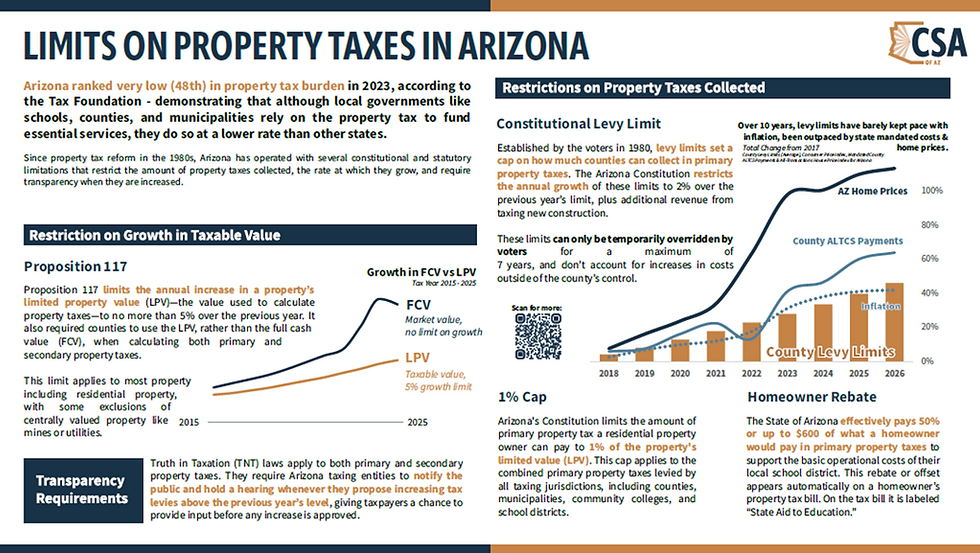
This week, we break down how Arizona’s property tax system works, from how tax bills are calculated and who sets the rates, to the key taxpayer protections that keep costs relatively low. We also explore what property taxes fund across counties and the growing cost pressures, including state-mandated programs, that shape local tax policy.
Tune in to the episode to learn more, and explore our resources on property taxes below:
Explore our website for additional materials:
30 Million Acres: Arizona's Federal Public Lands
Did you know that over 40% of Arizona's land is owned by the federal government — and only about 17.5% of Arizona's acres are subject to the property tax as a result?
Arizona's 15 counties sit on top of over 30 million acres of federally owned land, making up about 41.6% of the entire state. National forests, Bureau of Land Management territory, military installations — none of it shows up on a local property tax roll. But counties are still responsible for to providing roads, law enforcement, search and rescue, waste removal and more across all of it.
To help offset that gap, Congress created two programs that provide resources for essential services - PILT & SRS.
Payment in Lieu of Taxes (PILT) — established in 1976 — is essentially the federal government's way of compensating counties for tax revenue they can never collect on exempt federal land. In Fiscal Year 2024, Arizona's counties received $48.3 million in PILT payments combined. For rural counties, this isn't just a nice bonus — it's a critical component of budgets.
Gila County, for example, has 96.5% of its land in public ownership, leaving property taxes collectible on only 3.5% of its territory.
Apache County's property tax rate would have had to increase by over 71% just to replace what PILT provides - something it can't do because it is bound by constitutional limits.
Coconino County is the second largest county in the continental United States -- and home to the Grand Canyon -- with 87% public land; however, the County must still provides services throughout the entire 18,661 square miles of its territory.
Secure Rural Schools (SRS) was created in 2000 to replace another revenue stream that had been drying up — timber revenue from national forests that historically helped fund rural schools and county road maintenance. Counties recently received back payments for FY 2024 SRS payments, about $9.5 million, all of which is required to be used on county roads or passed on to rural schools.
Did you know? PILT & SRS are actually linked. SRS payments count as "prior year payments" that get subtracted from the formula used to calculate PILT. So when SRS goes away, PILT's funding obligation technically increases — but only if Congress fully funds it. If PILT is underfunded at the same time SRS lapses, counties get squeezed from both ends, receiving less of both. Arizona counties are grateful to the Arizona congressional delegation for helping to secure PILT & SRS funds for the current year.
For more information, check out CSA's resource on Public Lands.
From Statehood Forward: Prop 108 and Prop 105? Two Major Voter Approved Acts That Shape State Policy
On this week’s segment of From Statehood Forward, CSA is taking a closer look at Arizona’s voter-approved proposition measures that allow residents to directly shape state law and policy. Propositions are a key part of Arizona’s system of direct democracy, giving voters the power to approve laws, amend the Constitution and set limits on the legislature. Arizona is 1 of just 26 states that allows for initiatives or referendum processes. Two notable examples, passed in the late 1900's, continue to play a major role in how laws are created and changed in the state today.
Proposition 108 (1992); Article 9, Section 22: Public Debt, Revenue, and Taxation
In 1992, Arizona voters approved Proposition 108, adding an important safeguard around state revenue increases. The measure requires a two-thirds supermajority vote in both the House and Senate for any legislation that results in a net increase in state revenue, including new taxes or fee increases.
The amendment was designed to make raising revenue more deliberate and difficult, ensuring that any such decision has broad legislative support. By setting a higher threshold than a simple majority, Proposition 108 continues to shape how lawmakers approach budgeting and tax policy in Arizona.
Proposition 105 (1998); Article 4, Part 1, Section 1, Subsection 6
Just a few years later, voters strengthened the power of citizen-approved laws with Proposition 105, often referred to as the “Voter Protection Act.” This measure limits the legislature’s ability to alter or repeal initiatives that have been approved by the voters.
Under Proposition 105, lawmakers must meet a three-fourths supermajority in both chambers to make even minor changes to a voter-approved measure, and they must also demonstrate that the change furthers the original purpose of the law. This ensures that the will of the voters remains central, even after a proposition has passed.
CSA at the Legislature: CSA Staff & County Leadership Testimony
As the legislative session pushes forward, CSA and county leaders and professional staff continue to engage with the Legislature through meetings with members, communicating with staff, and testifying before committees on issues of importance to county governments.
This week, staff testified on the following bills:
HB2270: county seal; authority; sheriff's posse (Marshall) (Text)
HB2324: fire code; municipalities; county buildings (Kupper) (Text)
HB2439: public cold plunge; rules; exemption (Bliss) (Text)
HB2494: certificate; environmental compatibility; zoning; exemption (Taylor) (Text)
HB2758: McMullen Valley; eligible entities; groundwater (Griffin) (Text)
SB1419: solar energy; inspection; contractors (Carroll) (Text)
SB1566: malicious delay; enforcement; penalty (Petersen) (Text)
SB1787: exactions; individualized determinations; appeal (Petersen) (Text)
Committee Meetings: March 23 – 26, 2026
Please find the full calendar of committees linked here as well as all live proceedings linked here. Committees subject to change.
Monday, March 23rd
9:00 am - House Committee on Health & Human Services (Agenda; Video)
1:30 pm – Senate Committee on Federalism and Family Law (Agenda; Video)
1:30 pm - Senate Committee on Military Affairs and Border Security (Agenda; Video)
2:00 pm – House Committee on Land, Agriculture & Rural Affairs (Agenda; Video)
2:00 pm – House Committee on Public Safety & Law Enforcement (Agenda; Video)
Tuesday, March24th
Wednesday, March 25th
9:00 am – Senate Committee on Regulatory Affairs and Government Efficiency (Agenda; Video)
10:00 am – Senate Committee on Health and Human Services (Agenda; Video)
1:30 pm - Senate Committee on Judiciary and Elections (Agenda; Video)
2:00 pm - House Committee on Federalism, Military Affairs & Elections (Agenda; Video)
2:00 PM – House Committee on Science & Technology (Agenda; Video)
2:00 pm – House Committee on Transportation & Infrastructure (Agenda; Video)
Thursday, March 26th
Session Timeline: Important Dates and Deadlines
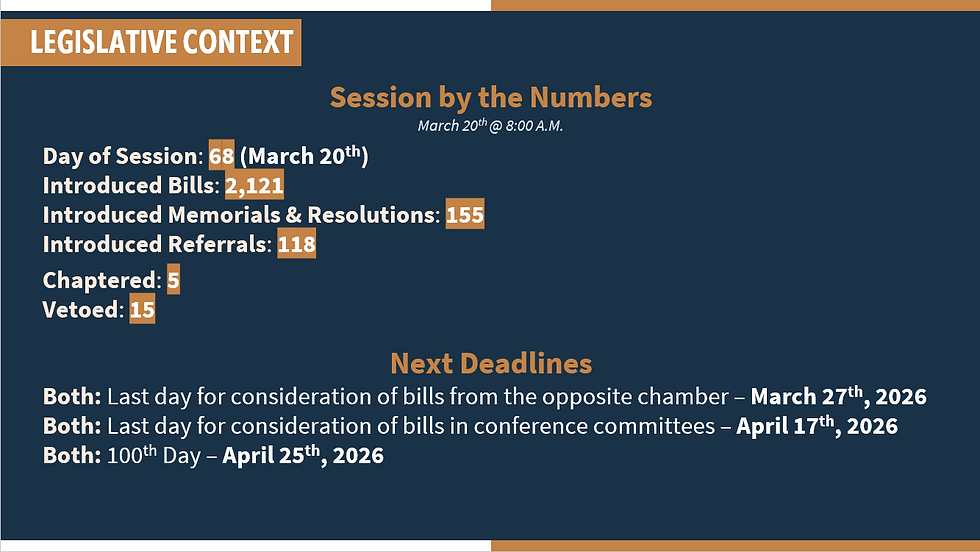
Friday, March 20th marks the 68th day of the legislative session, and the clock is still ticking down to the last day for bills to be heard in committee in the second chamber. This deadline has a similar caveat to the first committee deadline, in that appropriations committees will meet in both chambers the week after March 27th and that there will be a slimming of bills still in action.
As the 57th Legislature, 2nd Regular Session progresses, the Association will continue to provide updates on important deadlines as they pass. Please find additional deadlines linked here as well as listed below:
Lifelong Learning: Upcoming NACo Webinars
NACo Policy Insider Webinar Series: Understanding the Federal Landscape for Counties, March 26
Thursday, March 26, 2025; 3:30 p.m. - 4 p.m. ET
Last year's Inside Washington series is now NACo Policy Insider, a bi-weekly webinar offering an overview of the full federal policy landscape impacting counties, as well as deeper dives into specific policy areas, equipping county leaders with insights, context, and strategies to engage effectively on key issues from transportation and infrastructure, to public lands, to health and human services, and more.
To register, click here.
County Data Governance Decoded: Aligning Strategy with Government Needs
Monday, March 30, 2026; 3:00 p.m. - 4:00 p.m. ET
As counties prepare for the transformative impacts of artificial intelligence, and evolving compliance demands, robust data governance strategies have become essential. This webinar will explore actionable techniques to modernize data frameworks to align with county priorities, improve asset inventories, refine retention policies, and foster data-aware cultures.
Featuring lessons learned from a panel of county leaders who participated in a data governance workgroup, attendees will gain insights into what works, what doesn’t, and how to align strategy for resilience and compliance. Topics will include aligning data and information governance, leveraging AI tools to enhance data quality, conducting governance audits, and implementing lifecycle management practices to reduce risks and improve efficiency.
To register, click here.


Comments