
CSA Biweekly Update (07.31.2026)
On the July 31st, 2026, edition of the CSA Update:
News from the 2026 NACo Annual Conference: Coconino County Treasurer Sarah Benatar Elected NACo Second Vice President, multiple Supervisors appointed to Presidential Committees!
Department of Interior Publishes Final Environmental Impact Statement: Post-2026 Operational Guidelines and Strategies for Lake Powell and Lake Mead
County Outreach Continues: CSA visits La Paz County, presents at the Arizona City/County Manager Association, and attends the National Conference of State Legislatures
Primary Election Results: Several Incumbents Lose their Seats, Others Fend Off Challengers
Legislative Referrals Face Legal Scrutiny, See Divergent Results at the Court: HCR 2040 and HCR 2048 dealt blows, others emerge unscathed
July Numbers Are In: JLBC Monthly Fiscal Highlights
A Look Back: Creatures of Statute: Under the Hood of CSA's Transportation Resolution
CSA's Legislative Summary and CFO Guide Now Available: Two Final Publications Summarize the Policy Changes in the 2026 Legislative Session
Save the Date: CSA Annual Policy Summit
Lifelong Learning: Upcoming NACo Webinars
News from the 2026 NACo Annual Conference: Coconino County Treasurer Sarah Benatar Elected NACo Second Vice President, multiple Supervisors appointed to Presidential Committees!
Congratulations, Second Vice President Benatar!
On July 20th, 2026, Coconino County Treasurer was elected Second Vice President of the National Association of Counties (NACo) by the Association's membership, putting her directly in-line to become NACo's President.
Treasurer Benatar is only the second Constitutional officer (or "row officer") to be elected into NACo's leadership, as well as the first Latina and first County Treasurer.
Treasurer Benatar took office as Coconino County's Treasurer in 2014, and was the youngest County Treasurer in Arizona history. Her candidacy for NACo leadership was endorsed by both the County Supervisors Association and the Arizona Association of Counties.
Congratulations, Second Vice President/Treasurer Benatar! We look forward to working with you!

Multiple County Supervisors appointed to Presidential Committees.
Each year, NACo's incoming President is given discretion to appoint NACo's members to various Advisory Councils. This year was no different, and Arizona had some elected officials appointed! Please find a list of Arizona appointees below:
Hon. Marco A. "Tony" Reyes (Yuma County Supervisor)
Member, Agriculture and Rural Affairs Steering Committee
Vice-Chair, Rural Development Subcommittee
Hon. Alberto Peshlakai (Navajo County Supervisor)
Vice Chair, Healthy Counties Innovation Council
Hon. John Fanning (Santa Cruz County Supervisor)
Member, Human Services and Education Policy Steering Committee
Vice Chair, Education, Children, and Families Subcommittee
Hon. Nikki Check (Yavapai County Supervisor)
Vice Chair, Public Lands Policy Steering Committee
Hon. Patrice Horstman (Coconino County Supervisor)
Vice Chair, Resilient Counties Innovation Council
Hon. Alton Shepherd (Apache County Supervisor)
Vice Chair, Rural Action Caucus (RAC)
Vice Chair, Transportation Policy Steering Committee
Hon. Lena Fowler (Coconino County Supervisor)
At-large Member, NACo Board of Directors
Vice Chair, Rural Action Caucus (RAC)
Vice Chair, Telecommunications and Technology Policy Steering Committee
Hon. Jeronimo Vasquez (Coconino County Supervisor)
Vice Chair, Transportation Policy Steering Committee
Hon. Rudy Molera (Santa Cruz County Supervisor)
Vice Chair, Transportation Policy Steering Committee
Department of Interior Publishes Final Environmental Impact Statement: Post-2026 Operational Guidelines and Strategies for Lake Powell and Lake Mead
Just this morning, following the inability of affected states to secure agreements to continue "major reservoir- and water-management documents and agreements developed to guide Colorado River operations through the persistently dry conditions" past 2026, the Department of the Interior released its Final Environmental Impact Statement.
County Outreach Continues: CSA visits La Paz County, presents at the Arizona City/County Manager Association, and attends the National Conference of State Legislatures
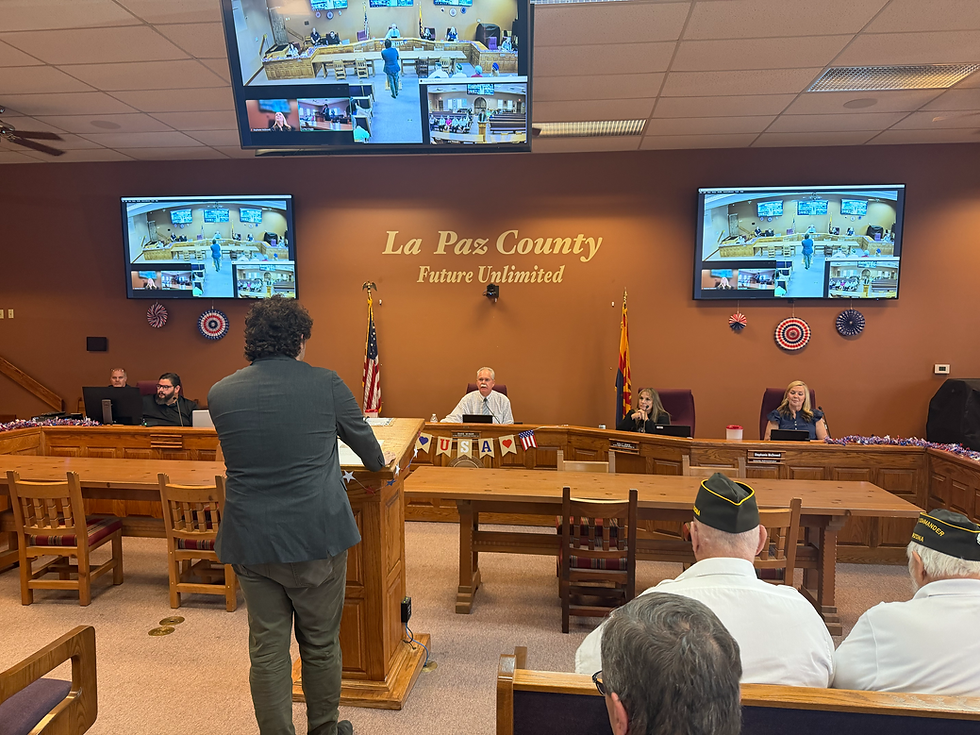
Monday, August 20th: Presentation to La Paz County BOS @ Parker, AZ
Though the Legislative Session feels like it just ended, CSA staff have been working hard to crisscross the state and provide in-person updates to each of the county Boards who participate in the Association. This means a road trip to each of the 15 county seats!
Last week, Association staff visited its seventh county this summer: La Paz County (Already Visited: Coconino, Navajo, Yavapai, Gila, Yuma, and Cochise). We look forward to joining the remaining 8 counties over the next few months - Greenlee and Graham counties are just next week.
Thank you to all of the counties that have hosted our team so far!

Friday, August 24th: Legislative Update for Arizona City/County Management Association @ Tucson, AZ
As all of our Supervisors know, the end of each legislative session heralds two main projects for CSA's Legislative Team: (a) wrapping up the session in a neat (ish) bow for those who had other things on their plate, and (b) preparing for the upcoming legislative session.
For the past number of years, CSA staff have been invited to present a Legislative Update alongside the League of Arizona Cities and Towns at the summer meeting of the Arizona City/County Management Association. We're always proud to join and are thankful for the opportunities this affords us to visit with the County Managers - and the city staff - who work with elected officials to keep government services running smoothly.

Monday, August 27th: National Conference of State Legislatures 2026 Legislative Summit @ Chicago IL
Each year, the National Conference of State Legislatures - a group where "every state legislator and staffer is a member of the organization" - holds a Legislative Summit where state legislators, their staff, and key stakeholders join together to attend sessions on some of the most pertinent policy topics that states are facing.
This year, with a significant focus on permitting for energy production and "high load users" (data centers, manufacturing), CSA sent staff to see how various states were processing this emergent policy area.
Items of interest that CSA staff attended included:
Decentralized Power: The Potential of Distributed Energy Resources
Speakers:
Brian Watts, Officer, Data and Research, The Pew Charitable Trusts
Logan Atkinson Burke, Executive Director, Alliance for Affordable Energy
Sharon Ray, State Representative, Ohio General Assembly
Utopia Hill, Chief Executive Officer, Reactivate
Powering Tomorrow: Emerging Energy Technologies:
Speakers:
Scott Kawasaki, State Senator, Alaska Legislature
Christina Walrond, Director, State Government Relations, X-energy
Kelt Wilksa, Senior Manager of State Policy for Advanced Transmission Technologies, Grid Strategies
Tom Erb, Government Affairs and Policy Manager, Fervo Energy
Data Center Debate: Supersized Hype or the Real Deal?
Speakers:
Ann Millner, State Senator, Utah Legislature
April Berg, State Representative, Washington Legislature
Brandon Ray, Senior Director, Associated Builders and Contractors
Bill Murray, VP of State & Electric Public Policy, Dominion Energy
The Balancing Act of Energy Demand and Affordability
Speakers:
Bridget Bartol, Executive Director, Industry and Regulatory Affairs, National Electric Manufacturers Association
Craig Sundstrom, Head of Energy and Sustainability Policy, Amazon
Kim Janas, Counsel to the Attorney General, Office of the Illinois Attorney General
Ryan Wiser, Senior Scientist, Berkeley National Lab

Primary Election Results: Several Incumbents Lose their Seats, Others Fend Off Challengers
The results of the 2026 Primary Election - which occurred on July 21, 2026 - have just about settled out.
While we've compiled a list of results, current to the day after the election (so vote counts may have changed), we wanted to provide you with the top-line takeaways below:
As two current County Supervisors were appointed to their seats after the 2024 General Election, they must run to fulfill the remainder of the term in 2026.
Incumbent Pima County Supervisor Andrés Cano won the Democratic nomination for Supervisorial District 5. He was appointed to the seat after former Supervisor Adelita Grijalva was elected to Congress. He did not have a competitor.
In Yavapai County, Camp Verde Mayor Marie Moore won the Republican nomination for Supervisorial District 2, beating Wiley Cline. The incumbent, Supervisor Dee Jenkins, was appointed to the seat after former Supervisor James Gregory resigned to become the Police Chief of Williams, Arizona. She did not seek election to the remainder of the term.
In five races, the incumbents lost:
In the race for the Republican nomination for the Superintendent of Public Instruction (Statewide), incumbent SPI Tom Horne loses the Republican nomination to State Treasurer Kimberly Yee. Yee received 322,387 votes while Horne received 283,333.
In the race for the two Republican nominations for the Corporation Commission (Statewide), incumbent Commissioner Nick Myers loses the Republican nomination to State Representative Ralph Heap. Heap received 299,319 votes while Myers received 283,126.
The other nomination for the two seats went to incumbent Corporation Commissioner Kevin Thompson, who received 325,029 votes.
In Legislative District 21 (Pima, Santa Cruz, and Cochise counties) incumbent State Representative Stephanie Stahl Hamilton loses the Democratic nomination to Miranda Lopez (the former Executive Director of the Pima County Democratic Party). Lopez received 8,677 votes while Stahl Hamilton received 8,395.
The other nomination for the two seats went to incumbent State Representative Consuelo Hernandez, who received 10,205 votes.
In Legislative District 24 (Maricopa County) incumbent State Representative Lydia Hernandez loses the Democratic nomination to Lisbeth Arescurenaga (a community organizer). Arescurenaga received 6,930 votes while Hernandez received 2,666.
The other nomination for the two seats went to Alberto Flores, who received 7,468 votes.
In Legislative District 6 (Apache, Coconino, Navajo, Mohave, Gila, Graham, and Pinal counties) incumbent State Representative Myron Tsosie loses the Democratic nomination (for State Senate) to former State Senator Jamescita Peshlakai. Peshlakai received 15,987 votes while Tsosie received 12,468.
It's the State Senate this time, so only one nominee!
In many other races, the incumbents prevailed. The closer contests included:
In Legislative District 27 (Maricopa County), where incumbent State Senator Kevin Payne narrowly defeated former State Senator Anthony Kern in the race for the Republican nomination for State Senate by 296 votes.
In Legislative District 20 (Pima County) where incumbent State Representative Alma Hernandez narrowly defeated former Tucson City Councilman Rocque Perez in the race for the Democratic nomination for State Senate by 600 votes.
Please find the most recent election results at the following LINK.
Legislative Referrals Face Legal Scrutiny, See Divergent Results at the Court: HCR 2040 and HCR 2048 dealt blows, others emerge unscathed
Continuing policy disagreements between Governor Hobbs and the State Legislature, and the resulting records the Governor has set for vetoes, has led to the Legislative Majority's continued use of legislative referrals to see their priorities made law.
Legislative referrals have one key benefit: they do not require any sort of gubernatorial approval to win passage. On the other hand, their success (or failure) is in the hands of the state's voters in the November General Election. Because of the Governor's being sidelined, opponents to measures shift their attention to (a) campaigning, and (b) the courts.
It is not uncommon to see legislative referrals become the subject of legal challenges. The key provision that many are challenged under is the "separate amendment rule" - Article 21, Sec. 1 of the State's Constitution - which states that "if more than one proposed amendment shall be submitted at any election, such proposed amendments shall be submitted in such manner that the electors may vote for or against such proposed amendments separately." The purpose of this is to prevent "log-rolling," or policies becoming successful because they're packed into a referral with other, unrelated, popular policies. In essence: the Constitution requires that referrals should be constructed in a way that allows you to vote on one issue - and only one issue - at a time.
This leaves larger referrals vulnerable to challenge, with opponents asserting that they violate this separate amendment requirement. As an armchair analyst, it's probably fair to say that these challenges are much more often dismissed than they are upheld (which is what makes some of these outcomes fairly interesting).
Here are the challenges we've seen so far:
HCR 2001: citizenship; identification; contributions; early voting (Kolodin)
CSA's Summary: Constitutionally requires that voters be provided the option for day-of, on-site tabulation. Requires every voter to show “valid, government-issued proof of identity” before casting a ballot. States that only citizens may register to vote, and that Arizona elections shall be decided solely the votes of eligible citizens. Prohibits foreign nationals from contributing or expending money or anything of value to influence an election. States that the people and the Legislature may enact laws governing elections provided they are reasonably connected to a legitimate state interest. Requires the Legislature to appropriate monies necessary for the implementation of these changes.
Challenge: Violation of separate amendment requirement. Lawsuit by Tempe City Councilmember Randy Keating alleges "packing too many unrelated measures into HCR 2001 alongside the new ID requirement" (KJZZ).
Outcome: Challenge dismissed, referral to move forward. Judge Adele Ponce "found coupling all of those provisions into a single amendment is allowed under the law, because they all deal with 'election integrity" (KJZZ).
HCR 2003: interscholastic; intramural athletics; biological sex (Bliss)
CSA's Summary: Beginning January 1, 2027, requires each athletic association that sponsors an interscholastic or intramural sport to designate each sport based on the sex of participating athletes. Prohibits a school or athletic association from authorizing an individual to use a provided restroom, locker room or other private space integral to athletic engagement that is not designated for the individual's sex.
Challenge: Violation of separate amendment requirement. Lawsuit by Will of the People PAC (Progress Arizona) states that "HCR addresses two unrelated issues - transgender students in sports and access to bathrooms and other facilities - in violation of the Arizona Constitution" (KJZZ).
Outcome: Challenge dismissed, referral to move forward. Judge Gregory Como noted that "Both provisions limit the freedom of transgender students to participate in athletics, whether it be on a girls' team or using an athletic facility (i.e. locker room,) ... the fact that one provision is broader than the other does not mean they are unrelated" (AZCentral).
HCR 2040: school districts; labor organizations; resources (Olson)
CSA's Summary: Beginning January 1, 2028, prohibits school districts and school district employees from using public monies and resources to support a labor organization's operations, performing labor organization activities during working hours or distributing any communications in a manner that consumes public resources on a labor organization's behalf. Contains broad language that prohibits the state or any of its political subdivisions from “negotiat[ing] with a labor organization an exclusive representation agreement, collective bargaining agreement, memorandum of understanding, contract or other agreement regarding the terms and conditions of employment.”
Challenge: Violation of separate amendment requirement. Lawsuit by the Arizona Education Association pointed out that while most of the bill was specific to school districts, a later provision broadly prohibited any political subdivision from negotiating with any labor organization (KJZZ). This attracted the ire of other labor organizations, like the Arizona Police Association, who felt that they would have been impacted.
Outcome: Challenge upheld, referral knocked off of ballot (cannot be amended to fix). Judge Gregory Como noted that "The Court finds no ambiguity in the phrase 'this state or any political subdivision of this state may not negotiate with a labor organization' ... far from limiting the term to teachers' unions or school employee associations, the definition does not even mention such organizations" (Arizona Mirror).
Appeal? The State Legislature has stated that they will not appeal the ruling. While that may seem surprising, the Legislature's choice to put language to the ballot that targeted all unions who deal with political subdivisions - including the Arizona Police Association and the Professional Firefighters of Arizona, who they've largely appeased via legislation - was seen as an "own goal." The broad language significantly broadened the coalition against the measure - which would have otherwise been just the teachers' unions - and attracted some ill will. This is a mulligan they are likely grateful for.
HCR 2044: preferential treatment; discrimination; prohibited acts (Montenegro)
CSA's Summary: Constitutionally prohibits the state — defined as “this state … or any other political subdivision in this state” — from (a) compelling an applicant/employee/contractor to endorse or support preferential treatment for (or discrimination against) any individual on the basis of race or ethnicity, (b) spending public monies to operate or contract for an office or position responsible for promoting preferential treatment toward/discrimination against an individual/group on the basis of race/ethnicity, or (c) implementing a disciplinary policy that treats students/employees differently on the basis of race/ethnicity. Contains a number of other related provisions. (2026 Session)
Challenge: Violation of separate amendment requirement; 1st Amendment concerns. Lawsuit filed by Will of the People PAC (Progress Arizona) asserts that some provisions prohibiting race-based discrimination are already included in state and federal laws, and that "lawmakers only included those provisions to provide cover for the parts of the law that would ban training and other policies that focus on disparate treatment people have experienced based on race, discussions of 'race-based privilege,' and similar topics" (KJZZ). The PAC also alleges that the bans infringe on freedom of speech.
Outcome: Challenge dismissed, referral to move forward. Judge Julie Mata concluded that the referral does not violate the separate amendment rule (Capitol Times).
HCR 2048: military families; scholarship accounts (Way)
CSA's Summary: Constitutionally prohibits the state from “confiscating” monies from any scholarship account of a qualifying student who is a child of a military family. Invalidates any law or measure passed on or after November 1, 2026, that violates the outlined prohibition.
Challenge: Violation of separate amendment requirement. Lawsuit by the Arizona Education Association asserts that the provision's language that would deem entirely invalid any referral passed that would take any scholarship money away from military families is a violation of the separate amendment requirement (KJZZ).
Outcome: Challenge upheld, referral knocked off of ballot (cannot be amended to fix). Judge Joseph Kreamer noted that "although the two aspects of Prop. 145 are 'facially similar,' they still contain 'multiple sections of the Constitution, combine subjects that have historically been treated separately, and perhaps most importantly, are qualitatively dissimilar" (12 News).
Appeal? Unlike HCR 2040, the State Legislature will appeal the ruling on HCR 2048. HCR 2048 can best be understood as "the big one" in that it serves as the Legislature's primary defense against the "Protect Education" measure that the Arizona Education Association is running to make numerous reforms to the Empowerment Scholarship Accounts program. Avoiding the possibility of this referral becoming effective is an issue of great importance to the Legislative Majority, which is why they engaged in numerous negotiations to try and avoid it being sent to the ballot.
July Numbers Are In: JLBC Monthly Fiscal Highlights
The Joint Legislative Budget Committee (JLBC) recently released its July Monthly Fiscal Highlights, providing a preliminary look at Arizona’s General Fund revenue through fiscal year 2026.
Through FY 2026, general fund revenues were $22 million above the level assumed in the enacted budget after adjusting for tax conformity. However, actual gains to the level assumed in the baseline will be determined by actual levels of spending for FY 2026, data which will take several months to finalize. Additionally, while the state chose to fully conform to changes to the federal tax code outlined in H.R. 1, conformity impacts may continue through the tax extension filing deadline of October 3, 2026. Taken together, these factors could impact the state’s current availability of resources.
High level figures are outlined below, as well as detail into the state’s major tax categories.
Total General Fund (GF) revenue collections for FY 2026 was $17.2 billion
At this collection level, FY 2026 revenues were $376 million above the Baseline revenue forecast released in January. Compared against the June enacted budget (which already incorporated revenue gains for FY 2026), the state gained $22 million.
Under the June 2026 enacted budget balance, the state’s projected ending balance for FY 2027 in $42 million.
Sales Tax:
Sales tax revenues grew by 3.8% in FY 2026, contributing to a forecast gain of $70.3 million relative to the baseline. Mixed performance was seen amongst the sales tax subclassifications, with retail/remote seller and restaurant/bar classifications growing at faster rates above FY 2025. Specifically, traditional “brick-and-mortar” or standard retail stores posted 2.0% growth throughout FY 2026, while the remote sellers category posted 16.5% growth for the year. The Department of Revenue (DOR) provides detailed taxable sales data by retail sector and interestingly, retail sales of motor vehicles and parts were only up by 0.3% throughout May of 2026.
Meanwhile, prime contracting revenues declined by (1.7)% in FY 2026, the first year of outright declines in a decade. Detailed data from DOR indicates that net reductions were almost entirely attributable to residential construction, down by (16.1)% which was the largest percentage decline since the collapse of the housing market during the Great Recession. However, contracting taxes from non-residential construction activity grew by 11.5% through May of 2026, a significant portion of which was likely related to building and expansion of manufacturing facilities throughout the state.

Individual Income Tax:
Individual Income Tax collections totaled $5.73 billion in FY 2026, a 4.6% increase over the prior year and $332 million above the January Baseline. Withholding revenues increased by 3.9% from the previous year, commensurate with wage and salary growth. Payment revenues grew by 8.2% over the previous year, potentially resulting from high-than-expected capital gains payments in tax year 2025. Refund levels increased by 6.0%, generating a forecast gain of $242.7 million over the baseline, which had assumed much higher levels of refunds in anticipation of tax conformity.
Corporate Income Tax:
Net Corporate Income Tax revenues were $1.88 billion, increasing by 7.6% over the previous year and aligned with pre-tax corporate profits for the same period.
Insurance Premium Tax:
Insurance Premium tax collections were $944.7 million, increasing by 2.3% over the previous year and $(93.6) million below the baseline. Interestingly, the state’s contracted Medicaid health insurance providers pay around 50% of annual IPT collections, and while average Medicaid enrollment declined by (10.2)% in FY 2026, projected IPT collections actually increased due to substantial adjustments in capitation rates which outpaced these enrollment declines.
HURF Collections:
Highway User Revenue Fund (HURF) collections totaled $1.85 billion in FY 2026, increasing by 0.8% over the previous year and $(48.7) million below the January forecast.
Other Indicators:
JLBC also reports on various economic indicators for the month, including the Consumer Confidence Index, housing units, and SNAP enrollment. For the month of June, the Consumer Confidence Index was 91.2 in June, increasing by 0.6 points from the May level. Respondents cited lower oil prices as the main source of improvement, although feelings of pessimism pervade. In May, Arizona had a 12-month total of 31,274 single-family building permits issued, representing a (19.9)% decrease from the previous year. Multi-family building permits totaled 15,081 in May, (3.9)% below the previous year. In May, there were a total of 451,762 individuals receiving SNAP benefits, representing a year-over-year decrease of (50.4)% over the previous year.
To view the full fiscal highlights, click here.
A Look Back: Creatures of Statute: Under the Hood of CSA's Transportation Resolution
With our Policy Summit on the Horizon, it's never a bad time to brush up on some of the issues we know are crucial to counties! Check out our older Creatures of Statute podcast - Under the Hood of CSA's Transportation Resolution - below!
CSA's Legislative Summary and CFO Guide Now Available: Two Final Publications Summarize the Policy Changes in the 2026 Legislative Session
At the conclusion of each legislative session, the County Supervisors Association puts out publications summarizing key legislation that was signed into law. Please find the 2026 CSA Legislative Summary and CFO guide below!
First, please access the Association’s 2026 CSA Legislative Summary by clicking HERE.
The Summary provides brief summaries on county-relevant legislation signed into law during the 2026 Legislative Session, accompanied by links to the official text of the bill and effective dates. It also includes the previously-published briefing on the FY 2027 state budget and the ten referrals that voters will see on their 2026 General Election ballots.
Reminder: The General Effective Date for new laws is September 12, 2026.
Second, please access the Association’s County Budget & Audit Guide (better known as the CFO Guide, and updated for 2026) by clicking HERE.
Published annually, this guide serves as a practical reference for counties navigating budget development, audit requirements, legislative changes, and statutory compliance obligations. The updated edition incorporates relevant legislative updates from the 2026 legislative session and highlights changes affecting county budgeting, reporting requirements, and related processes.
Both publications will also be made available at https://www.countysupervisors.org/publications
Thank you for your patience as Association staff have worked to wrap up some of our final post-session deliverables. We’re hopeful that these will assist you and your staff as you work to implement county-relevant policies enacted in the 2026 Legislative Session. Please reach out if you have any questions about the contents of the Legislative Summary or the CFO Guide.
Save the Date: CSA Annual Policy Summit
In October 2026, Supervisors from across the state will meet in Coconino County for the Annual CSA Policy Summit. The 61 county supervisors use this event to vote on the Association's 2027 legislative, budget, and research agendas. Registration details will be out soon. Looking forward to seeing you all there!

Lifelong Learning: Upcoming NACo Webinars
Leading Without Blame: How Psychological Safety Strengthens County Cyber Resilience
Tuesday, August 11, 2026 | 3:00 p.m. - 4:00 p.m. ET
The most damaging breaches in county government rarely begin with a sophisticated exploit. They begin with a person — someone who is stressed, overloaded, or afraid to raise a hand. For counties defending elections, courts, emergency services, and water systems, with lean teams and tight budgets, the way leaders build culture and trust is one of the highest-leverage security controls they own.
This panel brings county leaders together to explore how psychological safety, authentic leadership, and a culture of belief — not box-checking — drive real cyber resilience. Panelists will share candid, on-the-ground perspectives on moving from performative compliance to operational commitment, treating people as the strongest control rather than the weakest link, and using AI to sharpen human judgment rather than replace it.
Key takeaways:
Psychological safety is a security control: teams that feel safe report incidents faster, conceal less, and recover more quickly from mistakes.
Resilience is built on commitment and belief, not checkbox compliance — and elected and appointed leaders set that tone from the top.
AI is a tool to enhance human judgment, not replace it; counties succeed by pairing a strong culture with practical guardrails.
To register, please click here.
NACo Policy Insider Webinar Series: Understanding the Federal Landscape for Counties, August 13
Thursday, August 13, 2026 | 3:30 p.m. - 4 p.m.
Last year's Inside Washington series is now NACo Policy Insider, a bi-weekly webinar offering an overview of the full federal policy landscape impacting counties, as well as deeper dives into specific policy areas, equipping county leaders with insights, context, and strategies to engage effectively on key issues from transportation and infrastructure, to public lands, to health and human services, and more.
To register, please click here.
Doing More With Less: How Counties Can Successfully Address Behavioral Health Crisis Response Needs
Thursday, August 20, 2026 | 2 p.m. - 3 p.m.
Increased workforce strain and rising complex care needs test county health departments’ ability to deliver high-quality care. Join John Eller, Regional Director of Health Management Associates and Kevin Denmark, Senior Vice President of Behavioral Health at Bamboo Health, for a practical discussion on strategies county health departments can use to maximize resources and improve care outcomes.
This webinar, in partnership with the National Association of Counties, will explore:
How automated real-time data and crisis management response tools help county health leaders improve care outcomes, workforce satisfaction and the bottom line
Key considerations for supporting high-need, complex populations, such as justice-involved individuals, Medicaid recipients and rural residents with limited access
Why the crisis care continuum is a critical area of focus for improving clinical and financial outcomes
Whether you're a county health officer, behavioral health director, or a local administrator navigating the realities of constrained resources, this session will give you a tangible roadmap for turning real-time technology into your most powerful and scalable workforce multiplier.
To register, please click here.


Comments